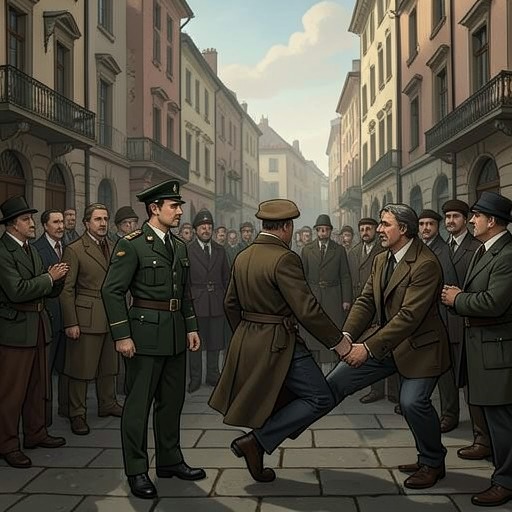
Dreyfus Court-Martial Trial and Conviction
An Officer and a SpyThe Dreyfus Court-Martial Trial and Conviction made a military judgment into a public spectacle, condemning Alfred Dreyfus to lifelong deportation and turning the presumption of guilt into a scene enacted before the Paris garrison. Its apparent finality depended on a proceeding that excluded the defense from secret evidence and, as later inquiries revealed, shut out questions that pointed toward the real author of the bordereau. The conviction endured for years, but its secrecy and the efforts to protect it ultimately helped expose the injustice it was meant to settle.
Verdict and Public Degradation
The First Permanent Court-Martial of the Military Government of Paris had met in camera before announcing its decision in public. Its central question was whether Dreyfus, a captain of the 14th Artillery Regiment and a General Staff probationer, had delivered confidential national-defence documents to a foreign power or its agents in Paris in 1894. The court’s answer was unanimous. It sentenced him to deportation for life to a fortified enclosure, discharged him from the army, and ordered his degradation before the first military parade of the Paris garrison.
The announcement became a carefully staged ceremony. At nine o’clock, four thousand soldiers brought their boots together as Dreyfus approached, escorted by four gunners. Their measured march, timed against the clock’s chimes, ended with the escort turning away and leaving him alone before General Darras. The general declared that Dreyfus was unworthy to bear arms and that he was being degraded in the name of the French people. The state’s judgment was thus delivered not only through a sentence but through the visible removal of a soldier from the army.
Dreyfus then marched around the four sides of the cour Morland in his torn uniform, passing each detachment under guard. The circuit lasted seven minutes by Picquart’s watch, though it seemed to drag on; each time Dreyfus called out that he was innocent, spectators answered with jeers and cries of betrayal. The Foreign Ministry observer and Colonel Sandherr interpreted his submission through antisemitic assumptions, treating his willingness to endure the humiliation as evidence of a supposed Jewish disposition rather than as a response to military custody. The ceremony did more than communicate a verdict: it presented the accused’s body to soldiers and spectators as an example of how the army dealt with a traitor.
A Trial Closed to the Defense
The later account of the conviction makes clear that the public announcement did not disclose everything on which the judgment rested. An agent reported that President Faure’s doctor, Gibert, had met Mathieu Dreyfus after breakfast at the Élysée and told him that secret evidence shown to the judges—not evidence presented in court—had secured the conviction. Picquart recognized the legal and political danger in that distinction: Dreyfus and his lawyer had never seen the material. Major Henry dismissed the disclosure as an ordinary procedural matter, but Picquart understood that its public revelation could lead people to question whether Dreyfus had received a fair trial.
The request to hold a later hearing in private made the same conflict explicit. At the proceedings Picquart witnessed, prosecutor Brisset argued that the evidence necessarily involved matters of national defence. Edgar Demange objected that Dreyfus had the right to be treated like any other accused person. The exchange exposed the competing claims that had shaped the original conviction: the military’s appeal to secrecy and national security, and the defendant’s claim to a process in which he could know and answer the case against him.
Evidence Excluded and the Investigation Contained
As Picquart investigated Esterhazy, General Gonse tried to keep that inquiry separate from the evidence on which Dreyfus had been convicted. Gonse told him to investigate Esterhazy if he wished, but to forget the bordereau. The instruction was consequential: the document that had implicated Dreyfus was also the means of connecting Esterhazy to the espionage case. Gonse’s proposed boundary would permit an inquiry in name while preventing it from testing the foundation of the conviction.
At a later inquiry into Picquart, he challenged that boundary directly. He pointed out that Esterhazy plainly wrote the bordereau and that the government’s principal handwriting expert accepted the match. When Picquart asked about falsified material in the dossier used to convict Dreyfus, the answer was that the subject lay outside the inquiry’s scope. The issue was therefore not simply whether new evidence existed, but whether the institutions examining the case would allow it to bear on the old verdict.
The secret dossier became a matter of public controversy when L’Éclair printed an anonymous article claiming that a secret file had proved Dreyfus’s guilt and urging the army to publish it. Picquart recognized that this was the first press mention of the file, and the timing alarmed him: he had just taken possession of the dossier. He counted the people who knew about it—military leaders, intelligence officers, the seven judges, the President, Gibert, and Mathieu—and concluded that the circle could no longer contain the information. The leak did not automatically correct the conviction. Picquart feared instead that the military chiefs would panic and intensify their efforts to limit the investigation.
From Pardon to Exoneration
When Dreyfus later accepted a pardon, Picquart objected that accepting it amounted to an admission of guilt. The distinction mattered because a pardon could release Dreyfus without overturning the judgment or restoring his honour. Jean Jaurès had prepared a statement for Dreyfus to issue on leaving prison: it accepted the government’s grant of freedom while insisting that he would continue working to overturn the judicial error of which he remained the victim. Release ended his imprisonment; it did not itself establish his innocence.
The eventual reversal came through successive legal and political steps rather than a single triumphant courtroom moment. In 1903, Jean Jaurès’s forensic speech in the Chamber of Deputies persuaded the new Minister of War, General André, to review the evidence. The André inquiry led the Criminal Chamber to take up the case and recommend review by the Supreme Court of Appeal. Political turmoil delayed the process, but on 12 July 1906 the Court of Cassation quashed the Rennes verdict and fully exonerated Dreyfus.
The following day, the Chamber of Deputies voted to restore Dreyfus to the army as a major and award him the Legion of Honour, by 432 votes to 32. A separate motion restored Picquart to the army at the rank he might have attained had he not been dishonourably discharged; it passed by 449 votes to 26. Picquart then returned to the École Militaire in the uniform of a brigadier general for Dreyfus’s medal ceremony. The public degradation that had once made the conviction visible was answered by a public restoration, although the intervening years could not be undone. The case’s final meaning lay in the distance between the verdict’s staged certainty and the slow legal process that established its failure.